Sunday, May 8, 2011

President States that He is "pro-Japanese"

At the recent unveiling of a memorial garden dedicated to a Japanese engineer noted for his construction efforts during the Japanese colonial period, President Ma Ying-jeou called himself "Japan's best friend" in Taiwan, saying that Japan's contribution to the construction of Taiwan could not be denied.

Ma and Mori at the opening ceremony.
Yoichi Hatta was a Japanese engineer credited with the construction of the Chianan Canal and the Ushantou Reservoir in southern Taiwan during the Japanese colonial rule. At the memorial garden's opening, Ma made a speech stating that although the handover of Taiwan to Japan after the first Sino-Japanese war was a tragedy, Japanese contributions to the construction of Taiwan could not be overlooked. Also present at the ceremony was Yoshiro Mori, a former Japanese Prime Minister, and a delegation of more than 200 Japanese visitors.

Ma in the past has been labeled as anti-Japanese by elements of both the Taiwanese and Japanese media, and this speech seeks to dispel such rumors. "I hope people can look at the love-hate relationship from different historical perspectives," Ma said.

This highlights a particularly contentious issue in Taiwanese politics, that of Taiwanese-Japanese relations. KMT supporters tend to be less open towards the Japanese because of war crimes committed against China during the Second World War, and the refusal of some of Japan's more nationalist ministers to acknowledge that war crimes were indeed committed. Native Taiwanese on the other hand, enjoy a very close relationship to the Japanese. From 1894-1945, Taiwan was Japan's attempt at creating a perfect colony. The natives were treated well and the Japanese built up infrastructure, bridging the rural south to the metropolitan north and generally improving the standard of living for most all of the country. Many native Taiwanese actually fought for the Imperial Army in China against KMT forces, which in turn led to tensions between the two factions after the KMT fled to Taiwan in 1949.

By expressing openness and friendliness towards the Japanese, Ma is separating himself from the anti-Japanese stance the KMT is known for, thus ingratiating himself with both the Japanese and the native Taiwanese. But at the same time, he may also be alienating himself from the more die-hard KMT supporters.

http://www.chinapost.com.tw/taiwan/national/national-news/2011/05/09/301622/Ma-calls.htm

Taiwan: CIA Factbook

A brief overview of Taiwan's entry in the CIA Factbook:

 Background:
In 1895, military defeat forced China to cede Taiwan to Japan. Taiwan reverted to Chinese control after World War II. Following the Communist victory on the mainland in 1949, 2 million Nationalists fled to Taiwan and established a government using the 1947 constitution drawn up for all of China. Over the next five decades, the ruling authorities gradually democratized and incorporated the local population within the governing structure. In 2000, Taiwan underwent its first peaceful transfer of power from the Nationalist to the Democratic Progressive Party. Throughout this period, the island prospered and became one of East Asia's economic "Tigers." The dominant political issues continue to be the relationship between Taiwan and China - specifically the question of Taiwan's eventual status - as well as domestic political and economic reform.

Population: 23,071,779 (July 2011)

Life expectancy at birth:
total population: 78.32 years 
     -male: 75.5 years
     -female: 81.36 years (2011 est.)
Religion: mixture of Buddhism and Taoism (93%), Christianity (4.5%), indigenous (2%)
Ethnic Groups: Taiwanese 84%, mainland Chinese 14%, indigenous 2%
Literacy: 96.1%

Debate on Taiwan independence has become acceptable within the mainstream of domestic politics on Taiwan; public opinion polls consistently show a substantial majority of Taiwan people supports maintaining Taiwan's status quo for the foreseeable future; advocates of Taiwan independence oppose the stand that the island will eventually unify with mainland China; advocates of eventual unification predicate their goal on the democratic transformation of the mainland.
No diplomatic representation to the US, though commercial and cultural relations are maintained through an unofficial instrumentality, the Taipei Economic and Cultural Representative Office in the United States (TECRO), a private nonprofit corporation that performs citizen and consular services similar to those at diplomatic posts.
GDP (purchasing power parity): 823.6 bn USD
PPP: 35, 800 USD
Unemployment rate: 5.9%
Telephones
     -main lines: 14.596 million
     -mobile: 26.959 million
Broadcast media
     -5 free-to-air nationwide TV networks
     -roughly 75 TV stations
     -85% of households utilize cable
     -around 170 radio stations
Internet users: 16.147 million
 19-35 years of age for male compulsory military service; service obligation - 2 years; women may enlist; women in Air Force service are restricted to noncombat roles; reserve obligation to age 30 (Army); the Ministry of Defense is in the process of implementing a voluntary enlistment system over the period 2010-2015, although nonvolunteers will still be required to perform alternative service or go through 4 months of military training.

https://www.cia.gov/library/publications/the-world-factbook/geos/tw.html

Universities Given Focus for Upcoming Election

Both the KMT and the DPP are turning to first time voters for the upcoming 2012 presidential election, with both candidates touring the country's university lecture halls and ingratiating themselves with students, who studies show are still mostly undecided.

DPP chairperson Tsai Ing-wen
For the past few months, President Ma Ying-jeou has been meeting university students and making media appearances about once a week. Tsai Ing-wen, the DPP Chairperson and candidate, says she plans to catch up. Tsai says her approach will be different from that of Ma's, focusing more on youth-oriented issues like student competition, the changing global landscape, and the experience of growing up, bolstered by her own experiences as a student in the US and the UK. Even during the DPP primaries, Tsai relied heavily on university students to boost her prescence in online blogs, discussions, and media appearances.

Tsai and the DPP observe that Ma and the KMT are out of touch with today's youth. Notably, a KMT lawmaker was forced to retract her comments when she suggested a "slap in the face" for students who did not stand up to speak with Ma at a question-and-answer session. A poll by cable news channel TVBS showed that although Ma leads Tsai in the polls by 1%, Tsai had a 9% lead over Ma in the age 20-29 category.

I think this focus on first-time voters and university students was at least in part brought upon by the 2008 US presidential election, where a large portion of Obama's base was the youth vote. Both parties now are looking to capitalize on this, but I think the DPP has the drop here because of its more liberal image, as opposed to the more conservative and traditionalist KMT. Though, I don't think it will be as much of a deciding factor as it was in the US because party split is ideological, but also in part involves heritage. People who immigrated or are the descendants of immigrants in 1949 with the remnants of the Nationalist Chinese government are typically more sympathetic to the KMT, whilst native Taiwanese and descendents of Ming and Qing dynasty settlers tend to identify more with the DPP.

http://www.taipeitimes.com/News/taiwan/archives/2011/05/09/2003502792

Freedom House lowers Taiwan's press ranking

Taiwan continues to drop down in the Freedom House press rankings, going from 43rd in 2008, to 47th in 2009, and now 48th in 2009. Taiwan is now ranked seventh in Asia-Pacific behind countries like Japan, Australia, and New Zealand, as opposed to be being ranked fourth in 2007.

The report stated: "A growing trend of marketing disguised as news reports, a proposed legal amendment that would limit descriptions of crime and violence in the media, and licensing obstacles all contributed to these concerns."

Another major concern was Taiwan's improving relations with China. The report fears that with deepening commercial ties, media owners and some journalists whitewashed news about China to protect their own financial interests. For example, the reports notes that in a column commemorating historical events in both Taiwan and China written for the Want Daily newspaper, the author failed to mention the Tiananmen Square massacre, despite being published on June 4th, the date of its anniversary. The China Times Group, which owns Want Daily, is owned by Tsai Eng-meng, a businessman with "significant commercial interests in mainland China," the report said.

Another major concern was government intervention in the media, citing how the Taiwanese National Communications Commission refused broadcasting licenses to Next Media, the parent of top-grossing news publications in Hong Kong and Taiwan. Another concern was embedded marketing, or advertising disguised as news, which was brought to national attention when Dennis Huang, a reporter at the China Times resigned in protest at the state of the media, in which both big business and government "buy positive coverage." Furthermore, at least three foreign journalists found that their Yahoo email accounts had been compromised in a manner similar to the attacks on Google's system in China.

The DPP responded by corresponding the drop in ranking with the presidency of Ma Ying-jeou, saying that "the decline in ranking highlighted 'serious problems' in interaction between government and the media."

Government officials have promised to make improvements addressing all issues and to achieve better performance next year, starting with the passing of the Budget Act, which bans embedded marketing by government agencies.

http://taipeitimes.com/News/front/archives/2011/05/04/2003502357

Chinese Official Calls to Oppose Independence

At the KMT-CCP (Kuomintang-Chinese Communist Party) forum in China yesterday, a senior Chinese official called for opposition to Taiwanese independence and for the recognition of the 1992 Consensus, a tacit understanding that states that there is only one China, but leaves each side to form its own interpretation.

Jia Qinglin, chairman of the National Committee of the Chinese People's Political Consultative Conference, a top Chinese political advisory body, made the remarks in fron of former KMT chairman Wu Poh-hsiung at the opening of the forum in Chengdu, Sichuan province.
Wu Po-hsiung in Beijing

The Democratic Progressive Party (DPP) widely refuses to recognize the 1992 consensus and insists it does not exist. To its credit, former Mainland Affairs Council chairman Su Chi admitted he coined the term in 2000, just before the beginning Chen Shui-bian's presidency, the first DPP president.

Also discussed at the forum was the issue of increased cross-strait flights for tourists from both countries. With the advent of hi-speed rail, domestic flight numbers have been steadily dropping in Taiwan, and the same is expected to happen with China when it completes its own hi-speed rails. Wu hopes that spare flights can be re-purposed to accommodate cross-strait travel. 

Over the years, the KMT's hardline stance against the mainland has softened and now the party seeks to restore and normalize economic and social ties with China.  The dialogue is kept alive by a precarious status quo, where China makes no attempt to regulate or govern Taiwan, and Taiwan makes no declarations of independence or radical political moves.  However, the DPP favors breaking all past ties with the mainland, for instance, the renaming of the Republic of China (which is Taiwan's present official name) to the Republic of Taiwan. It seems that this needlessly endangers Taiwan by provoking China, and even in the face of gradual reconciliation, the DPP still advocates a hardline independence stance.

http://www.taipeitimes.com/News/taiwan/archives/2011/05/08/2003502707

Saturday, May 7, 2011

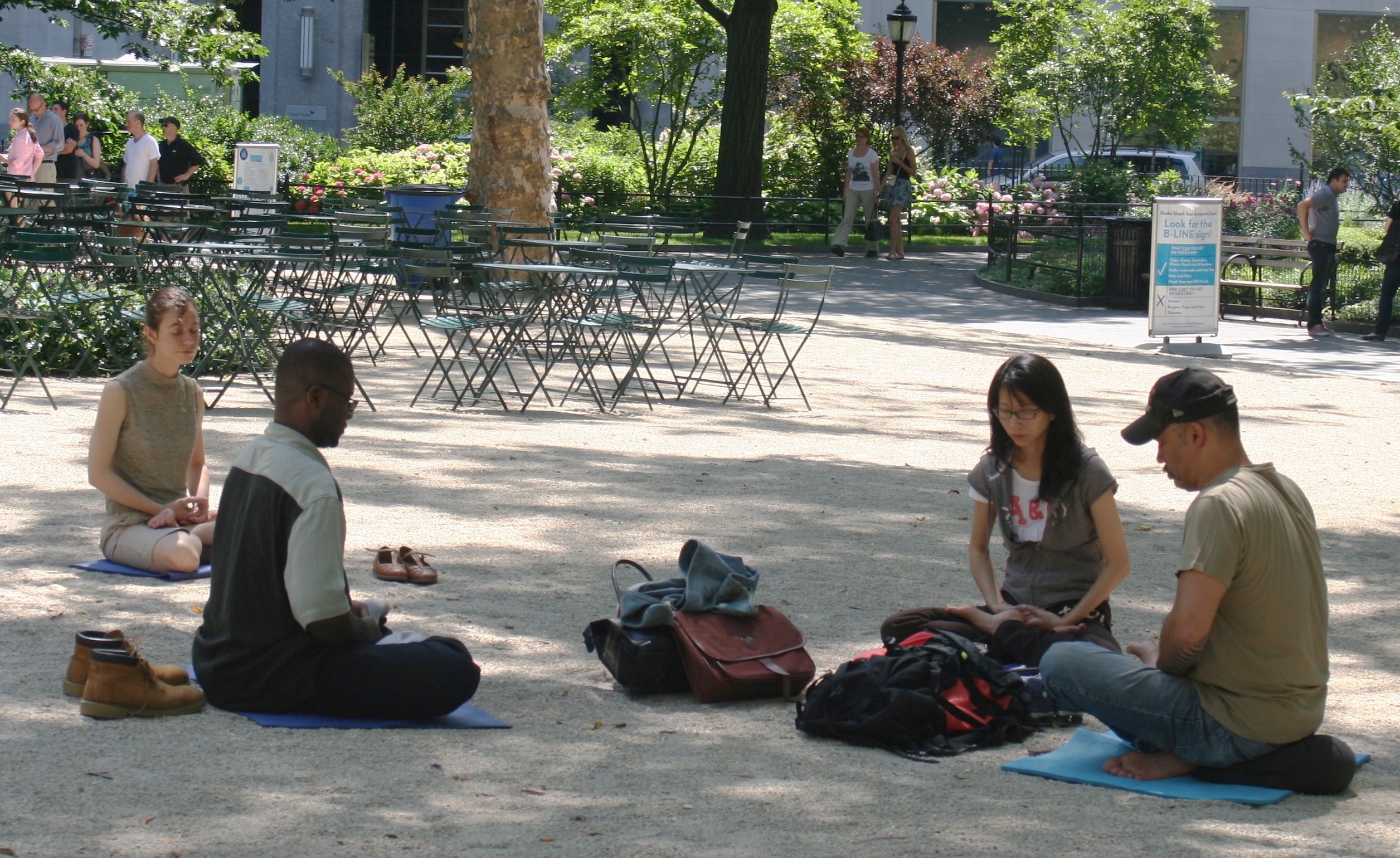
Study suggests meditation can inhibit aging

A research center/Buddhist retreat in Northern Colorado has been conducted trials in 2007 attempting to find links between regular mediation and observable significant health benefits.  The project, dubbed Shamatha, was done at the Shambhala Mountain Center over the course of two three-month periods and cost around 4 million USD, partly funded by private organizations. After several years of analysis and number crunching, the results from the study are just beginning to be published, and initial reports suggest dramatic results.

The report notes that participants in the study had significantly higher telomerase activity. Telomeres play a key role in the aging of cells, acting like a clock that limits their lifespan. When a cell divides, the telomeres get shorter, unless an enzyme called telomerase can build them back up. When a telomere gets too short, the cell cannot replicate and thus dies. Psychologist Elissa Epel from UC San Francisco said "If the increase in telomerase is sustained long enough, it's logical to infer that this group would develop more stable and possibly longer telomeres over time." The Shamatha project suggest that there is a definite link between meditation and cellular aging.

This article was interesting to me because it reads and feels very similar to articles we see here in the West about some new miracle cure all that was just confirmed by some scientific institute or another and how it can drastically improve your quality of life with little effort on your end. The human desire for easy fixes to complex problems shows through here, and just acai berry can get you down to a size 2, meditation can regenerate dying cells and chromosomes. That's not to say that there isn't credence to this study, but often these sorts of things are blown out of proportion. As to what it says about Taiwanese media, I believe it shows that as soon as a country hits a certain standard of living, luxury healthcare and posh science arise, which is telling about the standard of living in Taiwan.

http://www.taipeitimes.com/News/feat/archives/2011/04/26/2003501700/1

Monday, May 2, 2011

Thousands rally for labor rights

Protestors took to the streets yesterday demanding improvements in work environments, bridging the wealth gap, better support for those in poverty, the abolition of the temporary worker system, and an overall improvement in the quality of life. The majority of the march was organized by labor groups and unions, with others like women's and youth groups joining in. Some protestors dressed like Sun Yat-Sen, the founder of the Republic of China, to protest the ruling party's failure to enact his "good living for all" vision.

May Day protests in Taipei
The protest numbered around five thousand, with the biggest demand being an increase in the minimum wage, from 17,880 NT per month to 22,115 NT per month (an increase of about 130 USD). The demand is in response to the rising poverty rates, mostly due to increasing education costs which drive students deep into debt.

The Democratic Progressive Party (DPP) has expressed support for the protests. Spokesman Cheng Wen-tsan encouraged people to "voice your anger and dissatisfaction with the Ma Ying-jeou administration."

The last statement by the DPP is particularly telling about the political climate in Taiwan. The protests are, at best, a tangentially partisan issue and yet the DPP insists that these social woes be laid at the feet of the KMT. It's a political hotbed in Taiwan, with any and everything being turned into a political attack on the opposing party.

Source:
http://www.chinapost.com.tw/taiwan/national/national-news/2011/05/02/300732/Thousands-rally.htm